
An excavator breaker delivers over 300 impacts per minute—each impact sending a violent pressure shock through the hydraulic system. Under such extreme conditions, ordinary hydraulic hoses often fail from internal fatigue within just a few thousand cycles. The 4-spiral wire hose has become the standard for breaker lines, and the reasons lie in pulse pressure dynamics and solid engineering principles.
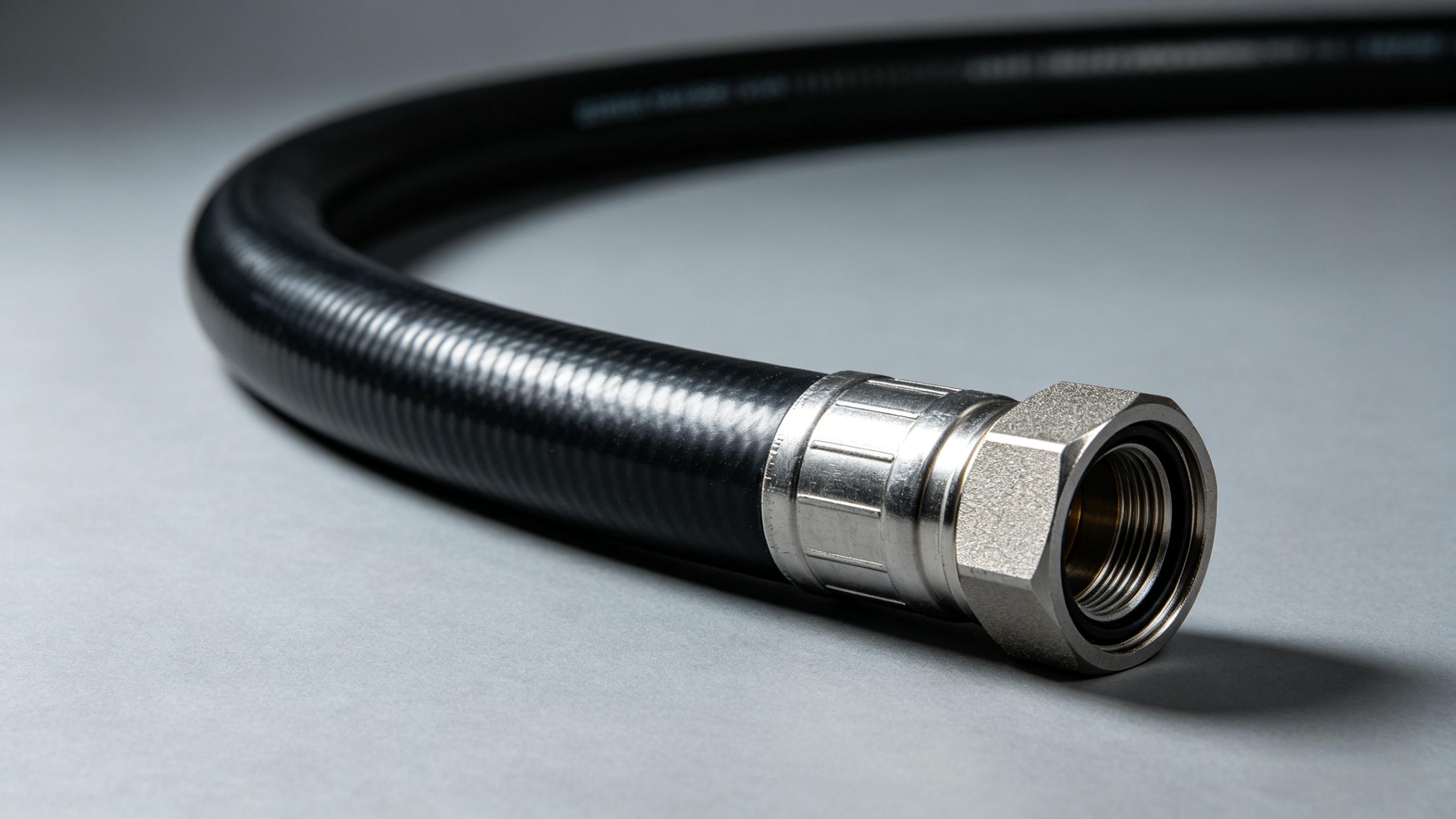
1. Pulse Pressure: The Real Threat to Breaker Lines
Breaker hydraulic systems typically operate at 16–35 MPa, but the steady-state working pressure is not the real threat—the pressure pulses generated with each impact are. When the tool strikes rock, system pressure spikes sharply from the working value to a peak, then drops back just as quickly. This alternating load occurs hundreds of times per minute. Over 8,000 operating hours, a breaker’s hoses endure tens of millions of pulse cycles.
During each cycle, steel wires undergo fretting wear from repeated tension and relaxation, while rubber layers accumulate fatigue damage from cyclic deformation. Failure is almost never a one-time overpressure burst—it starts with internal wire fractures that gradually propagate until the hose bursts. Therefore, a hose’s impulse fatigue resistance matters far more than its static working pressure rating.
2. Why “4 Layers”? — Stress Distribution and Fatigue Life Logic
The key difference between 2-layer braided and 4-layer spiral hoses is not the layer count—it’s how stress is distributed.
The 4-spiral hose uses four layers of high-tensile steel wire (tensile strength ≥1,770 MPa) wound in alternating left- and right-hand spiral directions. The structural advantage is that adjacent layers wound in opposite directions ensure that stress is distributed evenly across all layers when the hose is pressurized. Finite element analysis confirms that by optimizing the winding angle of each layer, the four layers can achieve balanced loading, significantly delaying fatigue crack initiation.
Equally important is the self-limiting crack mechanism of multi-layer independent winding—micro-cracks find it extremely difficult to propagate through all four layers simultaneously. In a 2-layer braided hose, once a single wire breaks, stress quickly transfers to adjacent wires, triggering a chain reaction of failure.
3. Pulse Test Data: The Overwhelming Advantage of 4-Layer Hoses
Under ISO 6803 pulse testing, 4SP/4SH hoses must withstand at least 400,000 pulses at 133% working pressure and 100°C oil temperature without leakage. Premium products far exceed this requirement.
Standard 4SP hoses typically achieve 800,000 to 1,200,000 pulse cycles under standard conditions, with some high-end series verified at over 800,000 cycles without leakage. If the inner liner is made of FKM (fluororubber), pulse life improves by approximately 80% compared to standard NBR liners. By contrast, standard 2-layer braided hoses often fail within 200,000 cycles—which, on a high-frequency breaker, could mean failure within just a few weeks.
4. Matching Working Pressure and Bore Size
Breaker operating pressure ranges from 16 to 35 MPa, while 4SP hoses have rated working pressures that decrease with bore size: DN10 at 44.5MPa, DN16 at 38.5MPa, DN19 at 35.0MPa, and DN25 at 30.0MPa. This sequence is not arbitrary—DN10 through DN19 fully covers the actual pressure range of breakers, while the burst pressure is strictly maintained at 4× working pressure, providing a generous safety margin.
Breaker main lines are typically specified in DN10 to DN19 sizes based on this matching logic: sufficient pressure capacity, adequate flow, and acceptable bend radius for the equipment‘s swing range (DN10 minimum bend radius is no less than 180mm).
5. Practical Selection Guidelines
Demand ISO 6803 pulse test reports from suppliers—static burst pressure data alone is not sufficient.
For cold northern winters or high-temperature environments, prefer FKM inner liner versions for better low-temperature flexibility and high-temperature aging resistance.
Strictly follow minimum bend radius requirements to avoid additional stress on the wire layers from over-bending.
For crimped fittings, use the skive process to ensure the ferrule teeth engage directly with the steel wires, preventing fitting loosening under impulse loads.
Summary
Breaker lines require 4-spiral hoses because they maintain structural integrity through tens of millions of pulse impacts. Pulse test data is the only meaningful measure of whether a hose can survive breaker duty—rated pressure alone means nothing without adequate pulse life. Focus on three key points during selection: pulse test reports, correct bore size matching, and inner liner material—only then will the hose withstand every impact that comes its way.
